
RollingGo × 2026 Yunqi Conference: Travel Is Being Reimagined
Hangzhou, September. At Yunqi Conference.

In front of a booth in Hall 4, someone spoke to an in-car display:
A few seconds later, three hotel options appeared on the screen, with prices, locations, and ratings clearly laid out. One tap to confirm, and the booking was complete.
This wasn’t a concept demo. It was a glimpse of the real state of in-car Agents at this year’s Yunqi Conference. Over several days, the RollingGo team watched an in-car system respond to requests like “Book me a hotel,” listened to all kinds of discussions about machines and intelligence, and spent a long time trying out AI glasses. Looking back through those notes, one thing became increasingly clear: people are getting better at expressing what they need, while machines are getting better at understanding those needs and turning them into action. Technology shaped much of the conference, but for travel, it once again brought us back to a very practical question: how does an idea about a journey actually become a journey?
Travel Is Being Rewired.
At the main forum, Alibaba Group CEO Eddie Wu said:
“Machines are becoming the primary force behind thinking, and intelligence is becoming a commodity that can be deployed at scale.”
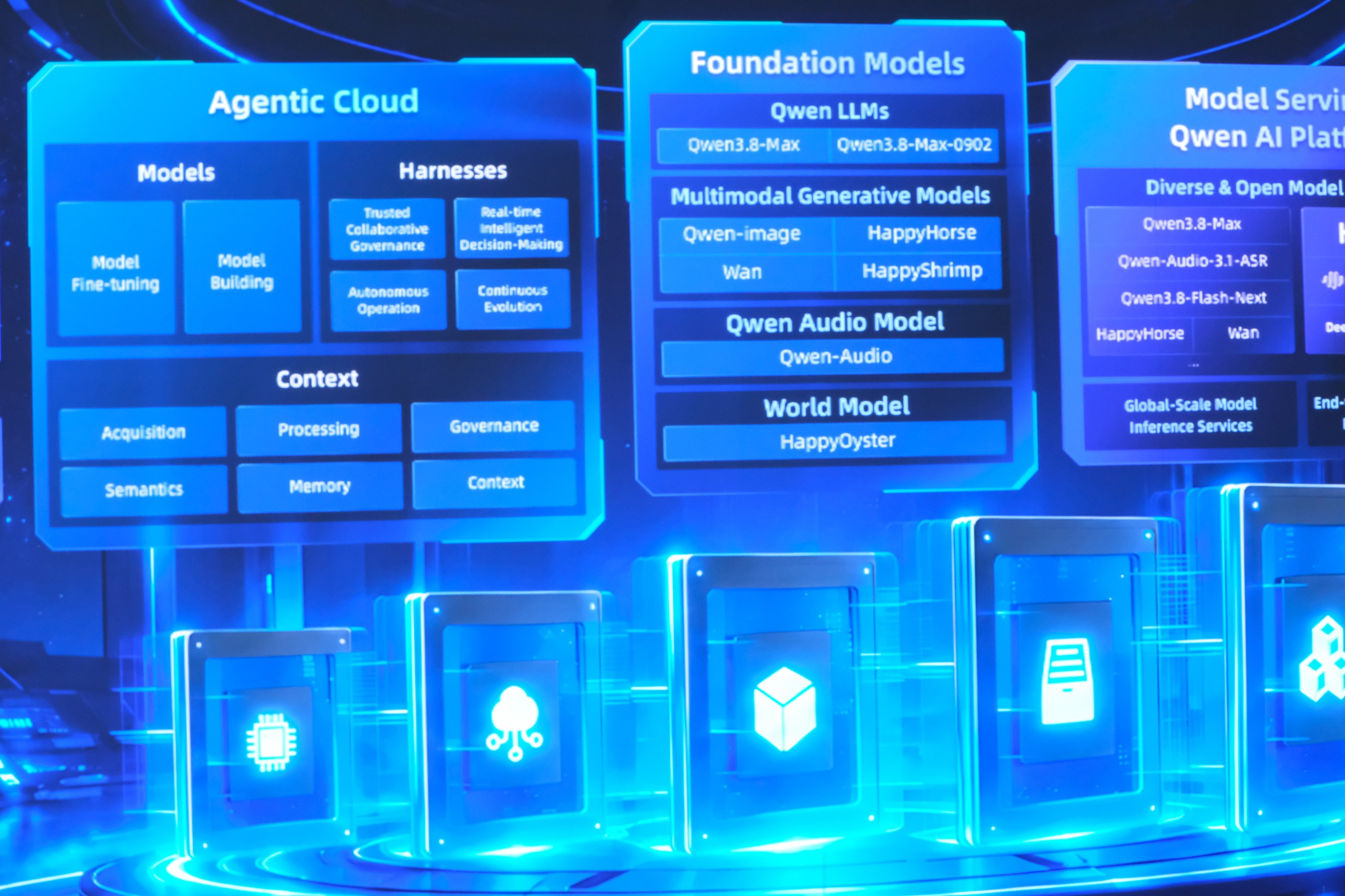
Hearing those words in person carried a different weight than reading them in an article. When intelligence becomes something that can be supplied at scale, much like water or electricity, it is not just computing power that gets repriced; the cost of making decisions changes as well. Planning a trip, comparing ten hotels, and finding and confirming a suitable room once meant browsing through a dozen pages and switching between multiple services. In the future, the same process may take little more than a few tool calls.
The entry point for travel booking is shifting from opening an app to simply telling an Agent what you need.
This means the flow of travel demand is beginning to change—from people searching for services themselves to Agents searching and making decisions on their behalf.
And whoever gets selected by those Agents will have a ticket into the next era of travel distribution.
Director Lu Chuan said at the conference: “AI is not a photographer capturing existing landscapes, but a creator of landscapes yet to be seen.”
Travel has always been about landscapes yet to come. We do not simply set out to see what is already there; we imagine journeys that have not happened yet and then find a way to make them real. What AI really needs to handle is the stretch between “imagining a trip” and “making it happen.” People setting out for unfamiliar cities are looking for things that a search engine alone cannot provide. Now, they have an Agent alongside them, and RollingGo’s job is to make sure that when the journey reaches the point of “booking a hotel,” the Agent can actually deliver.
More AI Entry Points, Fewer Places to Book
Qwen AI Glasses were one of the highlights of this year’s conference. With the glasses on, the world itself becomes an interface: look up to navigate, look down to confirm, or simply ask a question without having to reach for a phone. As computing disappears into the lenses, the traditional concept of “search” may gradually give way to something much simpler: just ask. The old routine of taking out a phone, opening an app, and typing in keywords is compressed into a sentence, or perhaps eventually into nothing more than a glance.
This reinforces something we have come to believe: **AI entry points are expanding and converging at the same time. **There is no contradiction between the two. In the short term, more ways of interacting with AI will emerge beyond the phone, whether through glasses, in-car systems, operating systems, or super apps. But whether it is a pair of glasses, an in-car system, or a super app, the products people ultimately use to “book a hotel” may well be concentrated in a relatively small number of dominant entry points rather than hundreds or thousands of niche services. As those entry points become fewer, every fulfillment partner selected behind them will need to be worthy of the trust placed in them.
The Hardest Part of Travel AI Isn’t Booking. It’s Getting Chosen.
One detail stood out to us at this year’s Yunqi Conference: the Qwen AI platform has been turning model capabilities into Skills, while its official advice to attendees was essentially, “Bring your Agent to explore the exhibition.” The Agent could read the agenda, identify relevant sessions, and plan a schedule, while people simply followed the plan and showed up.
It is a miniature version of a travel scenario: a vague idea goes in, and an actionable plan comes out. In an Agent-driven world, that process depends on tool calls, and travel sits directly in the middle of it.
Travel planning occupies the space between having an idea for a trip and actually making a booking. That is why travel Agents need strong AI travel-planning capabilities if they want a better chance of being selected by foundation models. Only when those planning capabilities are called can they eventually lead to a booking.
Imagine a user telling an in-car system, “Take the family somewhere this weekend.” The foundation model now has to decide which travel Agent to call. Does the itinerary make sense? Do the hotel recommendations fit the family’s needs? Is there enough room in the schedule to slow down and actually enjoy the trip? The model may compare all of these factors within milliseconds. If an Agent consistently falls short at the planning stage, it is less likely to be selected in the first place—and without being selected, there is no booking to win.
Planning determines whether a travel Agent has a chance of being chosen by an intelligent agent; booking only comes after that selection has been made. That is why we keep coming back to the same point: travel Agents need to make their AI travel-planning capabilities good enough to increase their chances of being called.
Travel Is Where the Standard for Delivery Is Especially High.
Another word that came up repeatedly at the conference was “delivery.” The shared impression across many of the discussions was that this year’s AI demonstrations were moving beyond simply showing “what AI can generate” and increasingly toward proving “what AI can reliably deliver in the real world.”
Travel is exactly the kind of industry where the standard for delivery is especially high.
If an Agent books a hotel and the guest arrives only to find that there is no room, they are not going to care which Agent made the mistake or which part of the system failed. They simply will not trust that entry point again. The supply side has to fulfill its promises if it wants to earn users’ trust in the entry points through which they interact with AI. Inventory needs to be real, prices need to be accurate, and when something goes wrong, there needs to be someone who can actually be reached to resolve the problem. If any one of these pieces fails, even the most intelligently planned itinerary is ultimately worthless.
That is why RollingGo built its product as an MCP: to translate the complexity of hotel fulfillment—including inventory, pricing, transactions, and after-sales service—into capabilities that Agents can understand, call, and orchestrate. Planning and fulfillment may be separate tasks at the technical level, but from the user’s perspective, they need to feel like one seamless experience.

Three Changes Are Already Underway
Another word that came up repeatedly at the conference was “delivery.” The shared impression across many of the discussions was that this year’s AI demonstrations were moving beyond simply showing “what AI can generate” and increasingly toward proving “what AI can reliably deliver in the real world.”
Travel is exactly the kind of industry where the standard for delivery is especially high.
If an Agent books a hotel and the guest arrives only to find that there is no room, they are not going to care which Agent made the mistake or which part of the system failed. They simply will not trust that entry point again. The supply side has to fulfill its promises if it wants to earn users’ trust in the entry points through which they interact with AI. Inventory needs to be real, prices need to be accurate, and when something goes wrong, there needs to be someone who can actually be reached to resolve the problem. If any one of these pieces fails, even the most intelligently planned itinerary is ultimately worthless.
That is why RollingGo built its product as an MCP: to translate the complexity of hotel fulfillment—including inventory, pricing, transactions, and after-sales service—into capabilities that Agents can understand, call, and orchestrate. Planning and fulfillment may be separate tasks at the technical level, but from the user’s perspective, they need to feel like one seamless experience.